
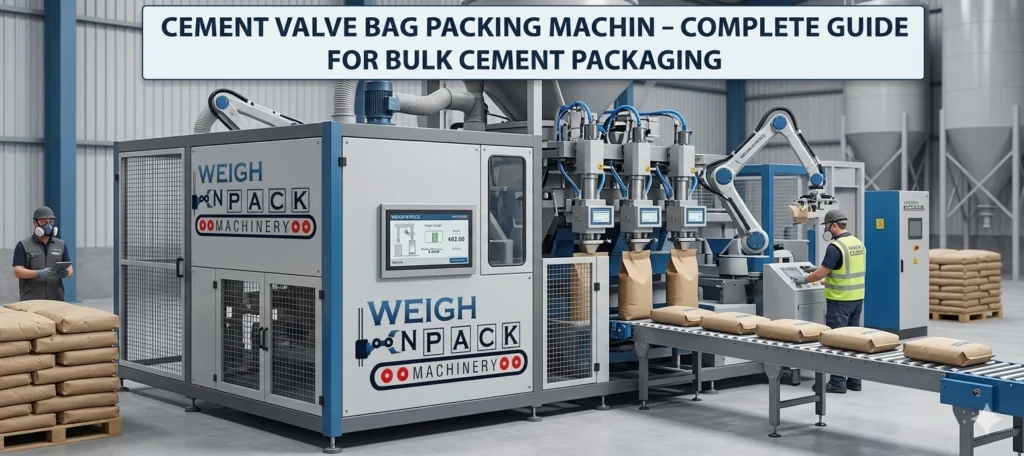
The cement industry handles large volumes of powder materials every day. To package cement quickly and accurately, industries use specialized equipment known as a Cement Valve Bag Packing Machine.
This machine is designed to fill cement into valve bags with speed, accuracy, and minimal material loss. It helps industries improve packaging efficiency while reducing labor requirements.
Today, cement manufacturers need faster production, consistent packaging quality, and cleaner operations. This is where valve bag packing technology becomes important.
A modern cement packing machine improves packaging performance and supports large-scale industrial production.
What is a Cement Valve Bag Packing Machine?
A Cement Valve Bag Packing Machine is industrial equipment designed to fill cement powder into valve-type bags.
Unlike open-mouth bags, valve bags have a filling opening that automatically seals when the bag becomes full.
This machine controls material flow, measures weight, and fills bags continuously.
It is also called:
- Cement packing machine
- Valve bag filler
- Cement bag filling machine
- Valve sack packing machine
- Automatic cement bagging machine
These systems are commonly used in cement plants because they provide fast and accurate packaging.
Why Cement Industries Use Valve Bag Packing Machines
Manual packaging creates several problems.
Workers cannot maintain the same filling speed continuously.
Bag weight variations create customer complaints.
Dust generation increases workplace problems.
Production capacity becomes limited.
A cement valve bag packing machine solves these problems through automated packaging.
Industries use these machines because they improve:
- Packaging speed
- Weight accuracy
- Production efficiency
- Cleanliness
- Labor productivity
This makes them essential for modern cement production.
How Does Valve Type Bag Packing Machine Work
Many industries ask How Does Valve Type Bag Packing Machine Work because understanding the process helps in selecting the right equipment.
The process starts when an empty valve bag is placed on the filling nozzle.
The machine begins transferring cement into the bag through controlled feeding.
As material enters the bag, the weighing system continuously measures weight.
When the target weight is reached, material flow automatically stops.
The operator removes the filled bag and places another empty bag.
This cycle repeats continuously for high-speed production.
Valve Bag Packing Machine Working Principle
Understanding the Valve Bag Packing Machine Working Principle helps explain why these machines are widely used.
The machine uses controlled feeding combined with weight measurement.
Material enters the filling chamber and moves through the filling nozzle.
The weighing system monitors filling accuracy.
The machine automatically adjusts material flow speed for better precision.
Once target weight is reached, filling stops automatically.
This principle ensures:
- Fast filling
- Accurate packaging
- Lower wastage
- Consistent bag weight
Main Components of Cement Valve Bag Packing Machines
Several important components work together.
Feeding System
Controls material movement from storage to filling nozzle.
Weighing System
Measures product weight continuously during filling.
Filling Nozzle
Transfers cement into valve bags.
Control System
Manages automation and machine operations.
Dust Collection System
Helps reduce airborne cement dust.
These components together create efficient packaging performance.
Types Of Valve Bag Filling Systems
Different industries require different machine configurations. That is why multiple Types Of Valve Bag Filling Systems are available.
Impeller Type Systems
Used for fine powder materials requiring high-speed filling.
Screw Feeding Systems
Suitable for controlled powder handling.
Air Packing Systems
Use air pressure for moving powder materials.
Gravity Systems
Best for materials with good flow characteristics.
Choosing the correct type depends on production requirements and material properties.
Advantages of Cement Valve Bag Packing Machines
These machines provide several important benefits.
They improve packaging speed.
They maintain accurate bag weight.
They reduce product wastage.
They lower labor dependency.
They create cleaner working conditions.
Most importantly, they improve overall production efficiency.
These benefits make them a valuable investment.
Industries That Use Cement Valve Bag Packing Machines
Although mainly used for cement, these machines are also used in other industries.
These include:
- Cement manufacturing
- Construction materials
- Dry mortar plants
- Fly ash production
- Gypsum industries
- Powder material processing
Any industry handling powder materials can benefit from these systems.
Dust Control in Cement Packaging
Dust is one of the biggest challenges in cement packaging.
Excessive dust creates:
- Product loss
- Worker health risks
- Dirty workplaces
- Higher maintenance requirements
Modern cement packing machines use dust collection systems.
These systems capture dust during filling operations.
This creates safer and cleaner production environments.
Production Capacity and Automation
Different industries require different production capacities.
Small operations may require semi-automatic systems.
Large cement plants usually prefer fully automatic solutions.
Automation improves:
- Filling speed
- Production consistency
- Labor efficiency
- Output volume
Higher automation generally supports larger production requirements.
Valve Type Bag Packing Machine Installation Guide
Understanding the Valve Type Bag Packing Machine Installation Guide is important before machine setup.
The installation process usually includes:
Proper machine positioning.
Electrical connection setup.
Compressed air connection if required.
Calibration of weighing systems.
Trial operation testing.
Operator training.
Proper installation improves machine performance and reduces future problems.
How To Maintain Valve Bag Filling Machine
Learning How To Maintain Valve Bag Filling Machine helps improve machine life.
Regular maintenance includes:
Cleaning dust accumulation.
Checking moving parts.
Inspecting weighing systems.
Lubricating mechanical components.
Monitoring electrical systems.
Routine maintenance reduces unexpected breakdowns and improves machine reliability.
Common Problems and Solutions
Sometimes packaging operations experience issues.
Uneven bag weight usually occurs due to calibration problems.
Dust leakage may indicate damaged seals.
Lower filling speed may occur because of material flow issues.
Regular inspections help identify problems early.
Preventive maintenance is usually more effective than reactive repairs.
Choosing the Right Cement Valve Bag Packing Machine
Before buying, businesses should evaluate:
Production requirements.
Material characteristics.
Automation needs.
Available space.
Maintenance requirements.
Future production expansion.
Selecting the right equipment improves long-term efficiency.
Future of Cement Packaging Technology
Industrial automation continues to improve.
Modern cement packaging machines are becoming smarter.
Future systems may include:
Real-time monitoring.
Advanced sensors.
Remote diagnostics.
AI-based optimization.
These technologies will further improve efficiency and packaging accuracy.
Conclusion
A Cement Valve Bag Packing Machine plays an important role in modern cement production.
It improves packaging speed, increases accuracy, reduces dust generation, and supports higher productivity.
Understanding machine types, working principles, installation methods, and maintenance requirements helps businesses make better decisions.
For industries handling large-scale cement packaging, investing in the right valve bag packing system can significantly improve operational performance.