
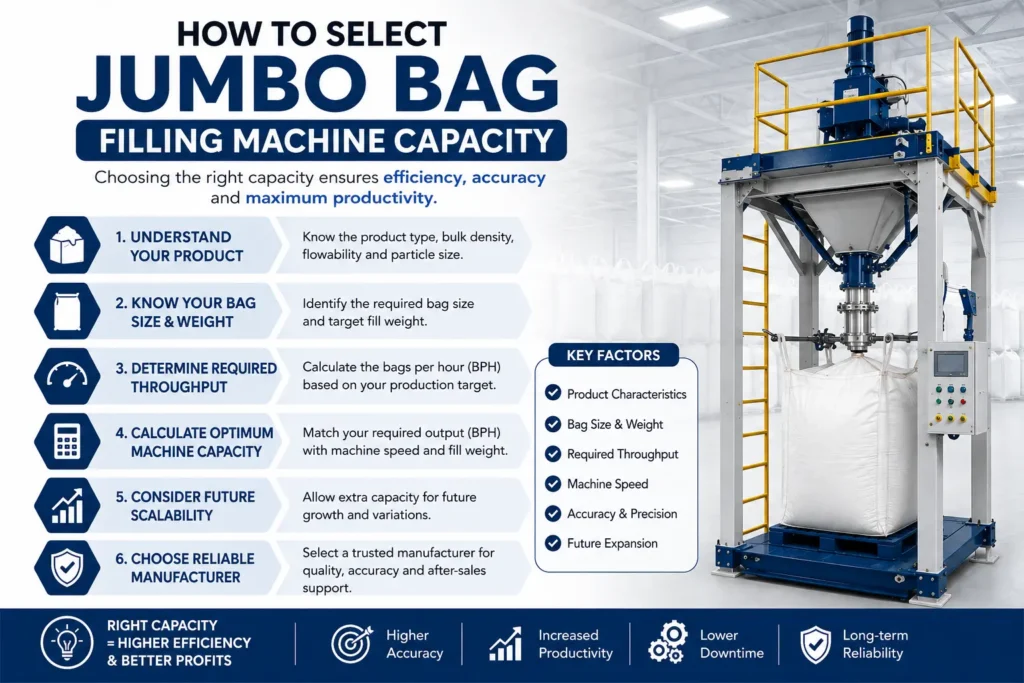
Choosing the right jumbo bag Packing machine capacity sounds simple until you start comparing bag sizes, materials, production targets, weighing accuracy, and machine speed.
A 1,000 kg jumbo bag does not automatically mean that every 1,000 kg filling machine will suit your factory. The material inside the bag matters. So does its flow behaviour, bulk density, required filling speed, bag design, and the number of bags you need to fill every hour.
The right machine should match your complete packaging process, not just one number on a specification sheet.
This guide explains how to select jumbo bag filling machine capacity using practical factors that matter in real industrial applications.
What Does Jumbo Bag Filling Machine Capacity Mean?
Jumbo bag filling machine capacity can refer to two different things.
The first is the weight capacity per bag. For example, a machine may be designed to fill 500 kg, 1,000 kg, 1,500 kg, or 2,000 kg bags.
The second is the production capacity, which tells you how many bags the system can fill within a specific period.
These two numbers are not the same.
For example, a machine filling 1,000 kg bags at 10 bags per hour handles 10,000 kg of material per hour. A machine filling 500 kg bags at the same rate handles only half that weight per hour.
Current manufacturer specifications show that jumbo bag filling systems commonly cover ranges such as 300 kg to 2,000 kg, while actual filling speed varies according to the material and machine configuration.
That is why you should never select a machine by bag weight alone.
Start With Your Required Bag Weight
The first question is simple:
How much material do you want to put into each jumbo bag?
Make a list of your standard bag weights before contacting a machine manufacturer.
For example, your production may require:
500 kg bags
1,000 kg bags
1,500 kg bags
2,000 kg bags
Some manufacturers provide machines across several of these ranges, while others customise the system around the customer’s requirements. WeighnPack itself states that its jumbo bag filling machines can be configured according to application requirements.
Do not choose a machine with a maximum capacity far above your actual requirement simply because a bigger number looks better.
Bigger is not automatically better.
The useful machine is the one that gives you the right combination of weighing accuracy, feeding control, speed, safety, and operating cost.
Calculate Your Required Production Capacity
After determining the bag weight, calculate how much material you need to pack.
Suppose your plant needs to pack 80 tonnes of material every day.
If you use 1,000 kg jumbo bags, you need approximately 80 bags per day.
If your operation runs for 8 hours, that works out to an average requirement of about 10 bags per hour.
This simple calculation gives you a starting point for machine selection.
You should also consider actual production conditions. Loading, bag positioning, weighing, discharge, movement, and other activities can affect the complete cycle.
Manufacturer specifications demonstrate why output should always be treated as application dependent. For example, current jumbo bag filling systems in the market list output ranges such as 5 to 30 bags per hour or 8 to 20 bags per hour depending on the material and configuration.
So instead of asking only, “How many bags per hour can the machine fill?”, ask:
How many bags per hour can this machine realistically fill with my material and my required bag weight?
That question will give you a much more useful answer.
Consider the Material You Are Filling
Material characteristics play a major role in selecting jumbo bag filling machine capacity.
Powders, granules, pellets, grains, minerals, cement, fertilizers, and chemicals do not behave in exactly the same way.
Some materials flow easily through a gravity system. Others need controlled feeding through a screw or another feeding arrangement.
WeighnPack lists gravity, screw, and belt feeding options for different material requirements. Its existing applications include products such as cement, fertilizers, grains, minerals, plastic granules, and powders.
This matters because the feeding mechanism affects how quickly and consistently material reaches the bag.
A machine that works beautifully with free flowing granules may require a different configuration for a fine powder.
So give the manufacturer accurate information about your product before finalising the machine.
Bulk Density Matters More Than Many Buyers Expect
Bulk density describes how much mass occupies a given volume.
This becomes important because two materials can have the same weight but require different volumes inside the jumbo bag.
Imagine filling 1,000 kg of a dense material and 1,000 kg of a much lighter material.
The weight is identical.
The required volume is not.
That difference can influence hopper sizing, filling head design, feeding arrangement, bag dimensions, and filling time.
This is one reason machine manufacturers need product information before recommending a configuration.
If possible, provide the manufacturer with your material’s bulk density, particle size, moisture condition, and flow characteristics.
More information at the beginning usually means fewer surprises later.
Match the Machine With Your Jumbo Bag Design
The bag itself also deserves attention.
FIBC bags come in different constructions, dimensions, filling openings, discharge arrangements, and lifting configurations.
ISO 21898:2024 covers design, construction, testing, marking, and safe use guidance for FIBCs intended for non dangerous solid materials.
Your machine should therefore match the actual bag you plan to use.
Check the following before ordering:
Bag weight capacity
Bag dimensions
Filling spout arrangement
Discharge arrangement
Loop configuration
Liner requirements
Bag holding method
Available headroom
A machine may have the correct weighing range but still require modification if the bag geometry does not match the filling station.
That is why sending an actual bag sample or technical drawing to the manufacturer can be extremely useful.
Decide Between Semi Automatic and Fully Automatic Operation
Capacity selection is also connected with automation.
A semi automatic jumbo bag filling machine can make sense when an operator can handle bag placement and related steps while the machine controls weighing and filling.
A fully automatic system becomes more attractive when production volume is high and the plant wants to reduce manual intervention.
WeighnPack offers both semi automatic and fully automatic jumbo bag filling solutions. Its published specifications describe configurations for 500 kg to 2,000 kg bags, with automation selected according to the application.
Do not select full automation simply because it sounds more advanced.
Ask whether your production volume actually justifies it.
If you fill a limited number of bags each day, a properly designed semi automatic system may be more practical. If your plant runs continuously and handles large volumes, automation can make more sense.
Check Weighing Accuracy
Capacity without accuracy is not much of a success.
A machine may fill hundreds of bags, but consistently overfilling each bag can increase material loss. Underfilling can create quality and commercial problems.
Modern jumbo bag filling machines commonly use load cell based weighing systems. Current manufacturer specifications show accuracy figures that vary by machine and application, including examples around ±0.2% to ±0.5%.
However, do not assume that one advertised accuracy figure applies to every product.
Material flow, feeding control, load cell selection, vibration, installation, and calibration can influence actual performance.
Ask the manufacturer how the stated accuracy applies to your specific material and target weight.
Think About Filling Speed Realistically
Faster filling sounds attractive, but speed should not become the only target.
If you increase material flow without maintaining proper control, you may create problems with weight accuracy, dust, spillage, or bag stability.
Many industrial systems therefore use controlled feeding. Some designs use coarse and fine feeding so that the system can approach the target weight quickly and then control the final portion more carefully. A current jumbo bag system from Sigma Instrumentation, for example, describes coarse feeding followed by fine feeding to improve control near the target weight.
The goal is not simply to fill the bag as quickly as possible.
The goal is to fill it quickly, accurately, safely, and consistently.
Consider Your Future Production
Your current requirement matters, but your future production matters too.
Suppose your plant currently packs 30 tonnes per day but plans to increase production significantly over the next few years.
Buying a machine that barely meets today’s requirement may create another investment sooner than expected.
At the same time, choosing a massively oversized system can increase the initial investment and make the equipment unnecessarily complex.
The better approach is to discuss your current production, expected growth, operating hours, bag weight, and desired automation level with the manufacturer.
A good machine supplier should help you find a practical configuration instead of simply pushing the biggest machine available.
Check Space and Plant Layout
Capacity is not only about kilograms.
Your available floor space and plant layout can affect the machine you can install.
Consider:
Machine footprint
Bag loading area
Hopper position
Conveyor space
Operator access
Maintenance access
Filled bag movement
Ceiling height
Connection with existing equipment
A jumbo bag filling machine must fit into the real production environment.
WeighnPack highlights customisation and integration with conveyors and other equipment as part of its bulk packaging solutions.
Before ordering, share your plant layout with the manufacturer whenever possible.
A few measurements taken before purchase can save a lot of headaches after installation.
Ask About Dust Control
If your product creates dust, include dust control in the capacity discussion.
Cement, fly ash, minerals, flour, chemicals, and other fine materials may require suitable filling head arrangements and dust extraction.
WeighnPack offers dust controlled jumbo bag filling solutions for applications such as minerals and fly ash, where fine particles can create additional handling challenges.
The right dust control arrangement depends on the material and the plant.
Do not treat it as an optional decoration added after the machine is selected.
It forms part of the complete filling system.
A Simple Way to Select the Right Capacity
Before requesting a quotation, prepare these details:
Product name
Material type
Bulk density
Particle size
Required bag weight
Bag dimensions
Daily production requirement
Required bags per hour
Number of operating hours
Semi automatic or fully automatic operation
Existing hopper or conveyor details
Available installation space
Dust control requirements
Once the manufacturer has this information, it becomes much easier to recommend the right machine configuration.
Why Capacity Should Be Selected as a Complete System
The best jumbo bag filling machine is not necessarily the one with the highest capacity.
It is the one that matches your material, bag, production target, weighing requirement, feeding system, automation level, plant layout, and future needs.
A 1,000 kg bag may require a completely different feeding arrangement from another 1,000 kg product.
That is the key point many buyers miss.
The number printed on the bag tells you the target weight. It does not tell you how the machine should handle the material.
Choose the Right Jumbo Bag Filling Machine With WeighnPack
WeighnPack designs and manufactures bulk packing and jumbo bag filling systems for industrial applications. Its published product range includes jumbo packing machines, stationary packing machines, screw conveyors, belt conveyors, and other packaging equipment.
The company states that its jumbo bag filling systems can be customised according to product characteristics, bag requirements, automation needs, and plant conditions.
If you are trying to determine how to select jumbo bag filling machine capacity, do not start with price or machine size.
Start with your product.
Then define the bag weight.
Calculate the required production rate.
Check material flow and bulk density.
Confirm the bag design.
Finally, match the weighing, feeding, automation, safety, and layout requirements.
That approach gives you a much better chance of choosing a machine that actually fits your production line.
After all, a jumbo bag filling machine should fit your factory’s requirements, not the other way around.