
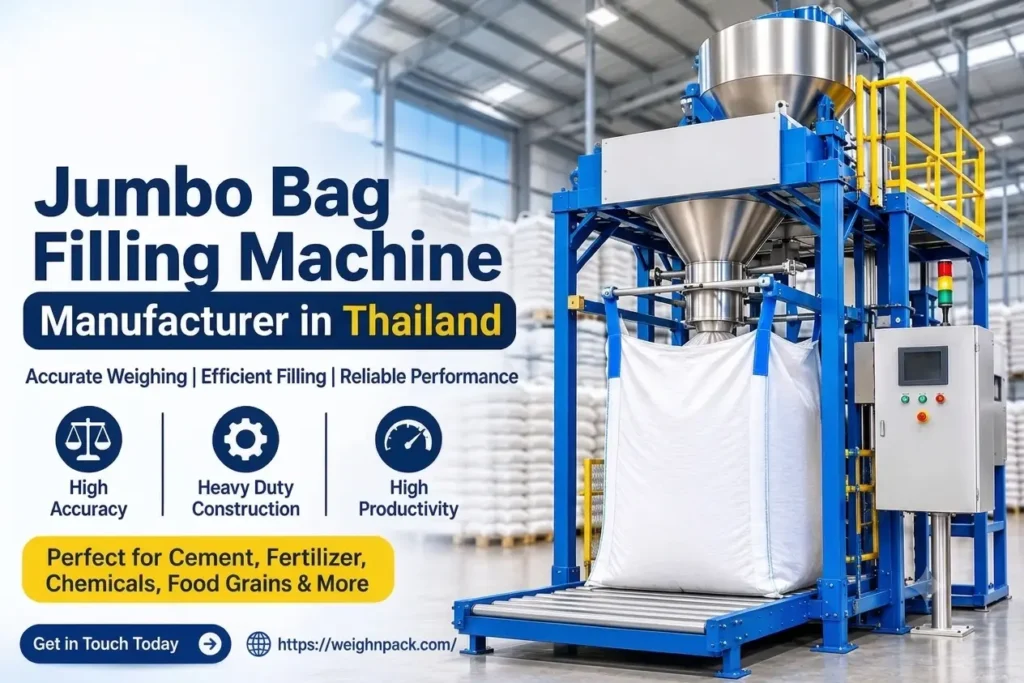
Industrial businesses in Thailand handle a wide range of bulk materials, including cement, fertilizers, plastic granules, agricultural products, minerals, and chemicals. Packaging these materials in large quantities requires more than just a filling hopper. Businesses need accurate weighing, controlled material flow, safe bag handling, and dependable production performance.
This is where a jumbo bag filling machine becomes an important part of industrial packaging.
If you are searching for a Jumbo Bag Filling Machine Manufacturer in Thailand, choosing the right equipment can help improve packaging consistency, reduce manual handling, and support your production requirements.
WeighnPack offers industrial weighing, filling, and material handling solutions designed around different materials and production needs. Its jumbo bag packing machines provide customizable configurations for businesses handling heavy bulk materials.
What Is a Jumbo Bag Filling Machine?
A jumbo bag filling machine is industrial equipment designed to fill large bags with bulk materials. These bags are also known as FIBC bags, big bags, or bulk bags.
Manufacturers commonly use these systems to package products that require larger storage and transportation quantities.
Depending on the application, the machine can include:
A material feeding hopper
A controlled feeding mechanism
A weighing system with load cells
A bag holding and support frame
A filling nozzle
An operator control panel
Optional dust collection arrangements
The weighing system measures the material during filling, while the feeding mechanism controls how quickly the product enters the bag.
This combination helps businesses achieve consistent filling results and manage bulk packaging more efficiently.
Why Thai Industries Need Efficient Jumbo Bag Filling Solutions
Thailand has manufacturing and processing businesses across agriculture, food production, chemicals, plastics, construction materials, and other industrial sectors.
These industries often handle materials that require bulk packaging for storage, transportation, and distribution.
Manual filling can become difficult when production volumes increase. Workers must handle heavy materials, maintain filling consistency, and manage repetitive operations.
An appropriately configured jumbo bag filling machine can address several of these challenges.
1. Better Weighing Control
Accurate weighing helps businesses maintain their required bag weight. A suitable load cell based system monitors the filling process and helps reduce weight variations.
2. Reduced Manual Handling
Bag filling equipment can reduce repetitive manual work. Operators can focus on supervising the process, positioning bags, and managing production activities.
3. Improved Production Flow
A properly selected machine can support a more organized packaging process. It can also integrate with conveyors and other material handling equipment where the production layout requires it.
4. Consistent Packaging
Controlled feeding and weighing help maintain more consistent filling results across production batches.
5. Better Material Management
The right filling arrangement can help control spillage and material loss. Businesses handling powders may also require dust collection and suitable filling connections.
Types of Jumbo Bag Filling Machines
Different materials behave differently during filling. Free flowing granules do not move like fine powders, so selecting the right feeding arrangement matters.
WeighnPack offers different jumbo bag filling configurations to support varying industrial applications.
1. Semi Automatic Jumbo Bag Filling Machine
A semi automatic system combines manual bag positioning with automated weighing and filling controls.
Operators position the empty bag, connect it to the filling station, and manage the required operating steps.
This arrangement can suit medium scale production facilities that want improved weighing control without automating every stage.
2. Fully Automatic Jumbo Bag Filling Machine
Fully automatic systems support more automated filling operations.
Depending on the configuration, they can include automatic filling cycles, conveyor integration, and PLC based controls.
These machines can suit production facilities that require a more integrated packaging process.
3. Gravity Type Jumbo Bag Filling Machine
Gravity based feeding uses the natural movement of materials to fill the bag.
It can work well with suitable free flowing materials, such as certain grains, seeds, and plastic granules.
The material’s flow characteristics determine whether this feeding arrangement is appropriate.
4. Screw Feeder Jumbo Bag Filling Machine
Screw feeders move material through a rotating screw mechanism.
This arrangement can suit powders and materials that need controlled feeding, including cement, fly ash, and certain chemicals.
5. Vibratory Feed Jumbo Bag Filling Machine
Vibratory feeding uses controlled vibration to move material through the filling system.
Engineers may consider this arrangement when the product requires a specific feeding pattern or controlled material movement.
The final selection should depend on actual material testing rather than assumptions.
Important Features to Consider Before Buying a Jumbo Bag Filling Machine
Finding a suitable supplier is important, but selecting the correct machine configuration is equally important.
Before purchasing equipment, consider the following factors.
1. Material Type
Start by identifying the material you want to pack.
Is it cement, fertilizer, plastic granules, rice, minerals, or chemical powder?
Each material has different flow characteristics. Particle size, bulk density, moisture content, and material behavior can influence machine selection.
2. Bag Weight and Capacity
Determine your required filling weight.
Some businesses need smaller bulk bags, while others require heavier packaging configurations. WeighnPack’s product information lists bag capacities from 500 kg to 2,000 kg, subject to machine configuration.
Always confirm the required capacity with the manufacturer before finalizing your purchase.
3. Weighing Accuracy
Weighing accuracy directly affects packaging consistency.
A load cell based weighing system can monitor the material weight during filling. However, actual accuracy depends on material characteristics, machine design, calibration, and operating conditions.
4. Production Requirement
Calculate how many bags your facility needs to fill per hour or per shift.
This information helps determine the appropriate feeding system, automation level, and equipment configuration.
5. Dust Control
Dust management deserves special attention when handling fine powders.
A suitable filling connection, sealing arrangement, and dust extraction system can help control airborne material and reduce product loss.
6. Maintenance and Technical Support
A packaging machine should support your production over the long term.
Check spare parts availability, maintenance requirements, technical assistance, and operator training before making a purchase.
Applications of Jumbo Bag Filling Machines Across Industries
Jumbo bag filling equipment supports several industrial applications.
Here are some common examples.
Agriculture and Fertilizer Industry
Agricultural businesses use bulk packaging equipment for suitable products such as fertilizers, seeds, grains, and animal feed.
A properly configured machine helps maintain controlled filling and organized packaging operations.
Cement and Construction Industry
Cement plants and construction material manufacturers handle materials such as cement, fly ash, sand, and other mineral products.
These materials require suitable feeding arrangements and effective dust management.
Chemical Industry
Chemical manufacturers use bulk packaging equipment for selected powders, granules, and industrial raw materials.
The machine configuration should account for product properties and any applicable handling requirements.
Plastic and Polymer Industry
Plastic manufacturers and processors often handle polymer granules, pellets, and plastic flakes.
Gravity or other suitable feeding arrangements can support bulk packaging depending on the material’s flow characteristics.
Food Processing Industry
Food processing facilities may use bulk bag filling equipment for grains, rice, flour, starch, and other suitable products.
Hygiene, cleaning access, and material compatibility should guide equipment selection.
Why Choose WeighnPack for Jumbo Bag Filling Machines?
Selecting a packaging machinery manufacturer requires evaluating more than the initial machine price. Businesses should consider equipment suitability, customization, weighing performance, and technical assistance.
WeighnPack focuses on industrial weighing, filling, and material handling solutions for different production environments.
Here are some important aspects of its machine solutions.
Customized Machine Configurations
Every production facility has different requirements. WeighnPack offers customization based on material type, bag size, weighing requirements, and production capacity.
Industrial Grade Construction
The company focuses on heavy duty machine construction for industrial packaging applications. Material options and machine specifications can vary according to the selected configuration.
Accurate Weighing Systems
WeighnPack incorporates weighing systems designed to support consistent filling operations and controlled material measurement.
Integration with Material Handling Equipment
Packaging operations often require more than one machine. WeighnPack also manufactures equipment such as screw conveyors, belt conveyors, and net weighers to support different production requirements.
Technical Assistance
WeighnPack provides technical assistance, maintenance guidance, troubleshooting support, and spare parts according to the machine and customer location.
These factors help businesses evaluate a packaging solution based on their actual operational requirements rather than choosing equipment based only on price.
How Does a Jumbo Bag Filling Machine Work?
Understanding the working process helps businesses evaluate whether a particular machine suits their production line.
A typical filling operation follows these steps.
Step 1: Bag Placement
The operator positions the empty jumbo bag on the machine’s supporting frame and secures its lifting loops.
Step 2: Weight Selection
The operator enters the required filling weight through the machine control system.
Step 3: Material Feeding
The feeding mechanism transfers material from the hopper into the bag. The system may use gravity, screw feeding, or another suitable arrangement.
Step 4: Weight Monitoring
Load cells monitor the material weight during filling.
Step 5: Filling Completion
The feeding system stops when the machine reaches the configured target weight.
Step 6: Bag Removal
The filled bag moves to the next stage of the packaging process, such as closing, stitching, pallet handling, or transportation.
The exact operating sequence depends on the machine design and automation level.
How to Select the Right Jumbo Bag Filling Machine Manufacturer in Thailand
When comparing manufacturers and suppliers, consider these points:
Product experience: Check whether the supplier understands your material and packaging application.
Machine customization: Confirm whether the equipment can match your required bag weight and production capacity.
Technical specifications: Request details about weighing systems, feeding mechanisms, and automation.
Installation support: Understand how installation and commissioning will work at your facility.
After sales assistance: Ask about spare parts, maintenance, troubleshooting, and technical support.
Total operating cost: Consider energy consumption, maintenance, labour requirements, and expected production performance.
A machine that looks affordable initially may not provide the best long term value if it does not match your production needs.
Jumbo Bag Filling Machine Price in Thailand
The price of a jumbo bag filling machine depends on its design, capacity, automation, and additional equipment.
There is no single price that applies to every industrial application.
Several factors influence the final quotation.
Required bag filling capacity
Semi automatic or fully automatic operation
Type of material being packed
Weighing system and accuracy requirements
Feeding mechanism
Dust collection arrangements
Conveyor integration
Customization requirements
For an accurate quotation, businesses should share their product details, target bag weight, required production output, and factory layout.
This information allows the manufacturer to recommend a more suitable machine configuration.
Get Industrial Packaging Solutions from WeighnPack
Choosing the right packaging equipment can make a significant difference to your production process. From material feeding and weighing to final bag filling, every stage should work together efficiently.
WeighnPack manufactures industrial packaging machinery for powders, granules, liquids, and bulk materials. Its product range includes jumbo bag packing machines, conveyors, liquid filling machines, net weighers, and stationary packing equipment.
For businesses in Thailand searching for a Jumbo Bag Filling Machine Manufacturer in Thailand, WeighnPack can help evaluate packaging requirements and identify a suitable machine configuration.
Whether you handle cement, fertilizer, plastic granules, minerals, or agricultural materials, the right packaging solution starts with understanding your product and production goals.
Contact WeighnPack to discuss your application, required bag capacity, and machine configuration.