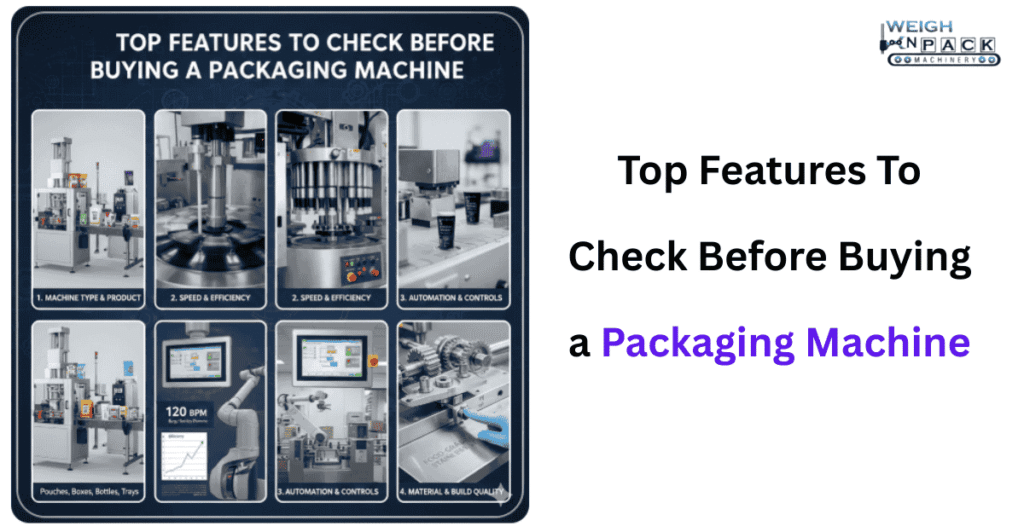
Buying a packaging machine is not just a procurement decision—it’s a long-term operational commitment. The right machine improves efficiency, reduces wastage, ensures product safety, and supports future growth. The wrong one becomes a bottleneck, increasing downtime, maintenance costs, and dependency on manual labor.
This guide explains the top features you should evaluate before buying a packaging machine, especially if accuracy, scalability, and consistency matter to your business. Whether you operate in food processing, FMCG, pharmaceuticals, agriculture, or industrial packaging, these factors determine real-world performance—not brochure claims.
1. Packaging Accuracy and Weight Consistency
Accuracy is the foundation of any reliable packaging system. Inaccurate filling leads to:
Product giveaway (loss of margin)
Compliance issues
Customer dissatisfaction
What to check:
Does the machine support precise weighing or volumetric control?
Is the weighing system load-cell based or servo-driven?
How stable is accuracy at high speeds?
High-quality packaging machines maintain consistency even during continuous operation, varying product densities, or environmental changes. This is especially critical for granular, powdered, or irregular products.
2. Type of Products the Machine Can Handle
Not all packaging machines are universal. Each is designed around product characteristics.
Before buying, evaluate:
Product form: solid, powder, liquid, granules, sticky, free-flowing
Fragility: does the product break or deform easily?
Flow behavior: consistent or irregular?
A good packaging machine should be engineered for your product category, not adapted as an afterthought. Machines optimized for snacks will behave very differently from those built for chemicals or pharmaceuticals.
3. Speed and Throughput Capacity
Speed is not just about packs per minute. It’s about stable output without sacrificing accuracy or seal quality.
Key considerations:
Rated speed vs real operational speed
Performance consistency during long shifts
Impact of speed on accuracy and seal integrity
Machines that operate smoothly at medium-to-high speeds with minimal vibration typically offer better long-term reliability than machines pushed to extreme limits.
4. Build Quality and Machine Structure
A packaging machine is an industrial asset. Build quality directly affects lifespan, maintenance frequency, and operational safety.
Check for:
Frame material (mild steel vs stainless steel)
Corrosion resistance
Weld quality and structural rigidity
Food-grade compliance where applicable
A well-built machine resists misalignment, reduces wear on moving parts, and handles continuous operation without frequent breakdowns.
5. Automation Level and Control System
Modern packaging machines rely heavily on automation for consistency and efficiency.
Important features include:
PLC-based control systems
Touchscreen HMI interfaces
Recipe memory for different products
Real-time error alerts and diagnostics
User-friendly controls reduce dependency on skilled operators and minimize human error. Machines that store multiple configurations also allow faster changeovers between SKUs.
6. Ease of Operation and Training Requirements
Complex machines slow down operations if operators struggle to use them.
Before purchasing, assess:
How intuitive is the control panel?
How long does operator training take?
Are instructions and parameters clearly defined?
Machines designed with operator logic in mind reduce mistakes, improve productivity, and lower training costs—especially important in high-turnover environments.
7. Changeover Flexibility
If your business handles multiple pack sizes or product types, changeover speed becomes critical.
Look for:
Tool-less or minimal-tool changeovers
Adjustable components
Digital parameter switching instead of mechanical adjustments
Fast and reliable changeovers help avoid production delays and make smaller batch runs commercially viable.
8. Maintenance Accessibility and Downtime Control
Even the best machines require maintenance. The difference lies in how easy it is to service them.
Evaluate:
Accessibility of wear parts
Availability of spare parts
Preventive maintenance requirements
Diagnostic alerts for early fault detection
Machines designed for easy access and predictable maintenance reduce downtime and extend operational life.
9. Power Efficiency and Energy Consumption
Energy costs are a silent operational expense. Efficient machines lower long-term ownership costs.
Check for:
Servo-driven systems instead of pneumatic-heavy designs
Optimized motor sizing
Idle power consumption levels
Energy-efficient packaging machines align better with sustainability goals and reduce utility expenses over time.
10. Safety Features and Compliance Standards
Safety is non-negotiable—both for operators and compliance.
Key safety elements include:
Emergency stop systems
Interlocked guards and covers
Electrical safety standards
Compliance with industry-specific regulations
A machine that prioritizes safety reduces accident risk, liability exposure, and operational disruptions.
11. Scalability and Future Expansion
Your packaging needs today may not match your needs two years from now.
Ask:
Can the machine integrate with upstream or downstream equipment?
Does it support higher capacity variants?
Is modular expansion possible?
Machines built with scalability in mind protect your investment and support business growth without full replacement.
12. Manufacturer Support and Technical Expertise
The machine is only as good as the support behind it.
Before finalizing, evaluate:
Installation and commissioning support
Availability of technical service
Documentation and training quality
Industry experience of the manufacturer
A knowledgeable manufacturer understands application-specific challenges and delivers better long-term value than a generic supplier.
Final Thoughts: Choosing the Right Packaging Machine
Buying a packaging machine should be a process-driven decision, not a price-driven one. The best machine is the one that:
Matches your product characteristics
Maintains accuracy under real conditions
Supports operational efficiency
Scales with your business
Minimizes downtime and manual intervention
By focusing on these critical features, you reduce risk, improve productivity, and ensure consistent packaging quality over the machine’s lifecycle.
For businesses seeking reliable, application-focused packaging solutions, evaluating machines through this feature-based lens leads to smarter, more sustainable investments.