
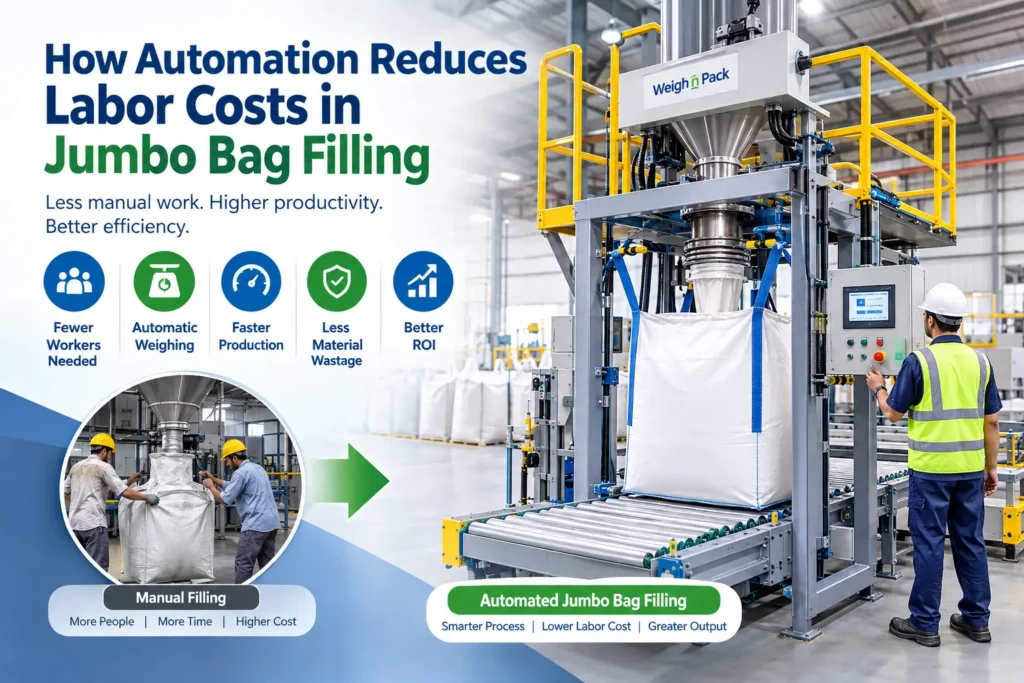
Jumbo bag filling looks simple until you have to fill hundreds of heavy bags every day.
In a manual setup, workers may need to position the bag, hold the filling spout, control material flow, check the weight, stop the filling process, and move the filled bag. When production increases, the same work requires more people, more supervision, and more time.
This is where automation changes the process.
An automated Jumbo Bag Filling Machine can handle important parts of the filling cycle with much less manual effort. Depending on the machine design, automation can control bag handling, material feeding, weighing, filling cut-off, and bag discharge.
The result is not simply “fewer workers.” The bigger advantage is that your existing workforce can spend less time doing repetitive filling tasks and more time handling valuable production activities.
For factories packing powders, granules, chemicals, fertilizers, minerals, plastic granules, food products, cement, and other bulk materials, this can make the packing process more consistent and easier to manage.
What Does Automation Mean in Jumbo Bag Filling?
Automation means using machines, sensors, weighing systems, controls, and other equipment to perform tasks that would otherwise require continuous manual work.
A modern Bulk Bag Filling Machine, also called an FIBC Bag Filling Machine, Big Bag Filling Machine, or Ton Bag Filling Machine, can automate several stages of the packaging process.
The exact level of automation depends on the machine selected.
A manual system may require the operator to perform most of the work. A semi-automatic system can automatically control filling and weighing while the operator handles bag placement and removal. A fully automatic system can go further by integrating bag handling, filling, weighing, discharge, conveyors, and other equipment.
WeighnPack’s existing machine range follows this basic automation structure, with semi-automatic and fully automatic solutions designed for different production requirements.
This flexibility is important because not every factory needs the same level of automation.
Why Manual Jumbo Bag Filling Requires More Labor
Manual filling creates a simple problem: people have to stay involved in many small tasks.
Imagine a factory filling 1,000 kg jumbo bags.
A worker may need to attach the bag loops, position the bag, connect the filling spout, monitor the filling process, check the weight, stop the flow at the correct point, and then prepare the filled bag for movement.
One bag may not look like a big task.
But repeat that process throughout an entire shift and the labor requirement becomes significant.
Manual operations also depend heavily on worker attention. If an employee is absent, production can slow down. If the material flows differently, the operator may need to adjust the process. If the weighing step is manual, errors can also create rework or material loss.
That is why labor cost is not only about monthly salaries.
It also includes supervision, overtime, training, replacement workers, repetitive handling, production delays, and the cost of mistakes.
How Automation Reduces Labor Costs in Jumbo Bag Filling
Automation reduces labor costs by taking over repetitive and time-consuming tasks.
Instead of having several workers continuously involved in every bag, the machine can perform much of the filling cycle automatically.
1. Fewer Workers Are Needed for Repetitive Tasks
The first and most obvious saving comes from reduced manpower dependency.
A semi-automatic or fully automatic filling machine can control material filling and weighing without requiring a worker to manually monitor every second of the process.
For example, an operator may load or position the empty bag, start the cycle, and then monitor the machine rather than manually controlling material flow throughout the entire filling operation.
In a fully automated system, even more stages can be integrated.
The goal is not to remove people from the production process. The goal is to reduce the amount of repetitive manual work each person has to perform.
This allows one trained operator to supervise a process that previously required several workers.
2. Automatic Weighing Reduces Manual Checking
Weight checking is another important part of bulk bag filling.
If workers manually estimate or repeatedly check the weight, the process becomes slower and more dependent on human attention.
Automated filling systems can use load cells and control systems to monitor the filling weight.
When the target weight is reached, the system can stop or change the filling flow according to the machine configuration.
WeighnPack’s jumbo bag systems highlight load-cell-based weighing and automatic filling control as important parts of the process.
This reduces the need for workers to constantly watch a weighing scale.
It can also help create more consistent filling results.
3. Faster Filling Means More Output With the Same Team
Labor cost is also connected to productivity.
Suppose a factory has a fixed number of workers. If those workers can produce more filled bags during the same shift because the machine handles repetitive work faster, the labor cost per bag can decrease.
This is an important difference.
Automation does not necessarily mean that the factory pays no labor cost. Instead, the same labor investment can potentially support higher production.
For high-volume plants, this can become more important than simply reducing headcount.
A faster automated filling process can help factories complete orders sooner, reduce waiting time between production stages, and improve the movement of finished bags.
4. Automation Reduces Operator Dependency
Manual filling depends heavily on individual workers.
If an experienced operator is absent, another worker may need additional training. If the process changes, the operator may need to learn a new method.
Automation makes the process more standardized.
The operator follows the machine’s defined operating procedure instead of manually controlling every stage.
A PLC-based control panel, sensors, weighing equipment, and automatic filling controls can work together to create a repeatable process. WeighnPack also describes PLC-based control as part of its dust-free jumbo bag filling systems.
This can make production easier to manage because the process is less dependent on one person’s experience.
5. Less Manual Handling of Heavy Bags
Jumbo bags can carry large quantities of material, commonly from hundreds of kilograms to around 2,000 kg depending on the application and bag specification.
Handling such bags manually is not a small job.
Automated bag filling equipment can use bag hooks, clamping systems, lifting arrangements, conveyors, and other integrated equipment to reduce unnecessary manual handling.
This does not mean every automated machine completely removes manual bag movement. The final setup depends on the machine design and factory layout.
However, reducing repeated heavy handling can reduce the amount of physical work required from operators.
That can make the overall packaging line easier to manage.
6. Less Rework Can Reduce Hidden Labor Costs
Not every labor cost appears on a salary sheet.
Rework is one example.
If a bag is underfilled, overfilled, poorly positioned, or spilled during filling, someone has to fix the problem.
That means extra handling.
Extra handling means extra labor time.
An automated Jumbo Bag Filling System can improve process consistency by controlling filling and weighing more systematically. WeighnPack states that automated systems are intended to improve filling accuracy and reduce material wastage.
When fewer errors occur, workers spend less time correcting those errors.
That is a hidden but important part of labor efficiency.
7. Reduced Material Spillage Also Saves Labor
Spilled material does not clean itself. Sadly, the floor has never learned how to use a broom.
Manual filling can create more opportunities for spillage, particularly when handling powders or free-flowing materials.
Automation can provide controlled feeding and filling. Depending on the material, systems may use gravity feeders, screw feeders, belt feeders, vibratory feeders, or other feeding arrangements.
Dust-control systems can also be integrated where required.
A cleaner filling process can reduce the amount of time workers spend cleaning the production area and recovering spilled material. WeighnPack’s dust-free filling solutions specifically connect controlled feeding and dust collection with cleaner operation and material savings.
Manual vs Automated Jumbo Bag Filling
The difference becomes easier to understand when the two processes are compared.
| Factor | Manual Filling | Automated Jumbo Bag Filling |
|---|---|---|
| Labor dependency | High | Lower |
| Weighing | More manual involvement | Automated weighing available |
| Filling control | Operator dependent | Machine controlled |
| Production consistency | Can vary | More consistent |
| Repetitive work | High | Lower |
| Heavy handling | More manual involvement | Can be reduced |
| Production scaling | Requires more manpower | Can support higher output |
| Process monitoring | Human dependent | Sensors and controls assist |
| Material wastage | Can be higher | Can be reduced with controlled filling |
The exact result depends on the machine configuration, product characteristics, production volume, and level of automation.
Semi-Automatic vs Fully Automatic Jumbo Bag Filling
Choosing automation does not always mean purchasing a completely automatic production line.
Semi-Automatic Jumbo Bag Filling Machine
A semi-automatic system usually keeps some manual activities, such as placing the empty bag and removing the filled bag.
The machine handles important functions such as filling and weighing automatically.
This can be a practical option for factories that want to reduce labor without making a very large investment in complete automation.
It is particularly useful when production is growing but full robotic or integrated handling is not yet necessary.
Fully Automatic Jumbo Bag Filling Machine
A fully automatic system takes automation further.
Depending on the design, the machine can integrate automatic bag handling, filling, weighing, bag release, conveyors, and other packaging equipment.
This type of system is generally suited to high-volume operations where reducing manual dependency and maintaining consistent production are major priorities.
WeighnPack describes fully automatic systems as suitable for larger production requirements and integration with conveyors and related equipment.
How to Calculate Labor Savings From Automation
Before buying an automated bulk bag filling machine, do not look only at the machine price.
Look at your current operating cost.
Start with the number of workers involved in jumbo bag filling.
Then calculate their total labor cost, including wages, overtime, benefits where applicable, and supervision.
Next, calculate how many bags you fill per shift and how many shifts you operate.
Now compare this with the expected labor requirement after automation.
For example, if a manual process requires several workers to continuously handle filling tasks but an automated system allows one operator to supervise the process, the difference in labor hours can become significant.
The calculation should also consider:
Labor savings + reduced rework + reduced material loss + increased output = potential operational benefit
The actual return on investment will vary from factory to factory.
Material type, bag size, production volume, automation level, machine speed, labor rates, and integration requirements all affect the result.
When Should You Consider an Automated Jumbo Bag Filling Machine?
Automation becomes more attractive when your factory has a high and consistent filling workload.
It can be worth evaluating when:
- Your production volume is increasing.
- Too many workers are involved in repetitive bag filling.
- Manual weighing is slowing production.
- You experience frequent filling or weight errors.
- Labor availability is becoming difficult.
- You need more consistent output.
- You want to integrate conveyors or downstream packing equipment.
A low-volume factory may not need the same level of automation as a large manufacturing plant.
The right machine should match the actual production requirement rather than simply having the highest possible automation level.
What Other Benefits Come With Labor Reduction?
The biggest advantage of automation may be labor efficiency, but that is not the only benefit.
A well-designed Jumbo Bag Filling Machine can also support better weighing consistency, faster production, cleaner material handling, reduced manual effort, and improved process control.
These benefits work together.
For example, better weight control can reduce material loss. Faster filling can improve output. Reduced manual handling can allow workers to focus on other production activities.
This is why automation should be viewed as a complete process improvement rather than simply a way to reduce the number of workers.
Why Choosing the Right Machine Matters
Automation only works well when the machine matches the product and production environment.
A powder may need a different feeding system from a free-flowing granule.
A chemical product may require different contact materials or dust-control arrangements.
A high-volume plant may need conveyor integration, while a smaller plant may only require semi-automatic filling.
Before selecting a machine, consider your material type, bulk density, bag size, target filling weight, required bags per hour, weighing accuracy, feeding method, dust characteristics, available floor space, and desired automation level.
This helps prevent a common mistake: buying a machine first and trying to make the factory fit around it later.
Why WeighnPack for Automated Jumbo Bag Filling?
WeighnPack provides Jumbo Bag Filling Machines and related bulk packaging solutions for industrial applications.
Its machine solutions cover different automation levels and can be configured around factors such as material type, filling method, weighing requirements, and production needs.
For a business looking to reduce labor dependency, the important question is not simply:
“Which machine is cheapest?”
A better question is:
“How much manual work can this system remove while maintaining the production speed and accuracy we need?”
That approach helps you select equipment based on total operating value rather than only the initial purchase price.