
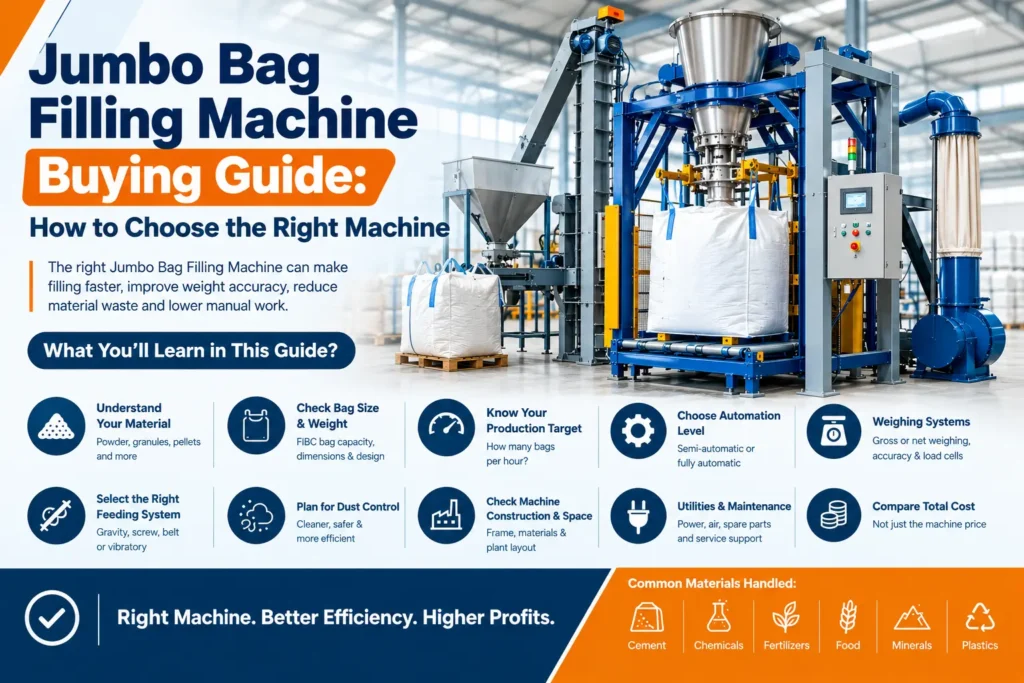
Buying a Jumbo Bag Filling Machine is an important decision for any factory that handles bulk materials. The right machine can make filling faster, improve weight accuracy, reduce material waste, and lower the amount of manual work.
But choosing a machine is not simply about looking at the machine price.
You also need to think about your material, bag size, filling capacity, production target, weighing accuracy, feeding system, dust control, automation, factory space, maintenance, and after-sales support.
A machine that works well for plastic granules may not be the right choice for cement powder. Similarly, a small production unit may not need a fully automatic system.
This Jumbo Bag Filling Machine Buying Guide explains the important points in simple language so you can understand what to check before buying a bulk bag filling machine, FIBC filling machine, or big bag filling system.
What Is a Jumbo Bag Filling Machine?
A Jumbo Bag Filling Machine is industrial equipment used to fill large bags with bulk materials.
These bags are commonly called FIBC bags, bulk bags, big bags, ton bags, or jumbo bags. Depending on the application, the filling system can handle materials such as powders, granules, pellets, fertilizers, chemicals, cement, minerals, grains, and other bulk products.
The machine normally combines a material feeding system with a weighing system and a strong bag support frame.
The basic process is simple.
The empty FIBC bag is attached to the filling machine. Material then moves from a hopper, silo, conveyor, or feeder into the bag. The weighing system monitors the material quantity. When the target weight is reached, filling stops or changes to a slower feeding stage.
Modern systems can also include dust collection, automatic bag clamping, conveyors, PLC controls, automatic bag release, and other equipment depending on the production requirement.
For example, WeighnPack’s current machine information describes configurations covering different feeding methods, automation levels, bag capacities, and material types.
Why Do You Need a Proper Buying Guide?
A jumbo bag filler is a long-term industrial investment.
Choosing only by price can create problems later.
For example, imagine a factory that needs to fill fine powder but buys a simple gravity filling system because it is cheaper. The material may not flow properly, dust may increase, and the operator may spend more time correcting the filling process.
The opposite can also happen.
A factory filling free-flowing granules may purchase an expensive, highly automated system even though a simpler configuration could meet its production requirement.
The goal is therefore not to buy the most expensive machine.
The goal is to buy the right bulk bag filling system for your application.
First Check the Material You Want to Fill
The first question in any jumbo bag filling equipment purchase should be:
What material will the machine fill?
Different materials behave differently.
A free-flowing material can move easily through a gravity feeder. Fine powder may require controlled feeding through a screw or auger system. Some materials may need vibration or belt feeding.
Powder Materials
Powders can include cement, fly ash, flour, minerals, chemicals, pigments, and other fine materials.
For powder applications, controlled feeding and dust management are especially important.
A screw feeder can provide controlled material flow, while a suitable dust collection or sealing arrangement can help reduce airborne particles.
Granules and Pellets
Plastic granules, fertilizer granules, grains, seeds, and similar materials often have better flow characteristics.
Depending on the product, gravity, belt, or vibratory feeding can be considered.
The correct choice depends on factors such as particle size, bulk density, flowability, fragility, and required filling speed.
Sticky or Difficult Materials
Some materials do not flow freely.
They may bridge inside a hopper or move slowly through the feeding system.
In such cases, the machine may require a specially designed hopper, agitator, vibration system, screw feeder, or another controlled feeding method.
This is why giving the machine manufacturer a material sample or detailed material information can be useful before final machine selection.
Check the Jumbo Bag Size and Weight
The next important factor is your FIBC bag capacity.
Common requirements may include 500 kg, 1,000 kg, 1,500 kg, or 2,000 kg bags, although actual requirements vary by application.
Do not select a machine only because it says “big bag filling machine.”
Check the actual bag dimensions and construction.
You should confirm:
Bag weight capacity, bag height and width, filling spout size, loop arrangement, bag inlet design, and required discharge arrangement.
The machine should safely support the filled bag during the complete filling cycle.
If you use different bag sizes, tell the manufacturer before ordering. A machine can sometimes be designed with suitable adjustment or configuration for multiple bag formats.
Decide How Many Bags You Need to Fill
Your daily production target is another major buying factor.
Suppose your factory needs to fill only a few bags each hour. A simple semi-automatic jumbo bag filling machine may be enough.
But if your factory needs continuous high-volume production, you may need a more automated filling line.
The important question is not simply:
“How fast is the machine?”
Instead, ask:
“How many finished bags do I need per hour, per shift, and per day?”
This gives the manufacturer a real production target.
Current WeighnPack machine information gives a general example of filling rates around 10–40 bags per hour depending on configuration, but actual output depends on material, bag size, feeding system, target weight, and machine design.
Choose the Right Automation Level
Jumbo bag filling machines can generally be designed around different levels of automation.
Semi-Automatic Jumbo Bag Filling Machine
In a semi-automatic system, the operator normally performs some bag-handling tasks while the machine controls the filling and weighing process.
This can be useful for medium-scale production where the company wants better consistency without investing in a complete automatic packaging line.
It can provide a practical balance between machine investment, manpower, and production requirements.
Fully Automatic Jumbo Bag Filling Machine
A fully automatic bulk bag filling system can reduce manual involvement in processes such as bag handling, filling, discharge, and material transfer.
It can also be connected with conveyors and other packaging equipment.
This type of system is generally considered when production volume is high and the factory wants a more continuous packaging process.
Automation should be selected according to production needs, not simply because “automatic” sounds better.
Understand Gross Weighing and Net Weighing
The weighing method is one of the most important technical points in a Jumbo Bag Filling Machine.
Gross Weigh Filling
In a gross weighing system, the bag is positioned on the weighing structure and material is filled into the bag while the system measures the increasing total weight.
The system stops or controls the feed when the target weight is reached.
This design can be simple and practical for many bulk materials.
Net Weigh Filling
In a net weighing system, the required quantity of material is weighed separately before it enters the final bag.
This approach can provide greater control over the material quantity and can be useful when accurate dosing is particularly important.
The choice between gross and net weighing should depend on your product, accuracy requirement, production speed, and overall plant design. WeighnPack’s existing technical content also identifies gross and net weighing as important configuration choices.
Check Filling Accuracy
Weight accuracy directly affects your product cost.
Suppose every bag contains slightly more material than required. The difference may look small for one bag.
But after hundreds or thousands of bags, the extra material can become significant.
That is why you should ask about:
Load cell quality, weighing controller, calibration process, repeatability, material flow control, and expected accuracy for your specific product.
Do not judge accuracy only from a general brochure number.
Ask the manufacturer how the stated accuracy was measured and whether it applies to your actual material and target bag weight.
Current WeighnPack specifications describe load-cell-based weighing and an example accuracy range of ±0.2% to ±0.5%, depending on configuration. Actual performance should be confirmed for the intended application.
Select the Correct Feeding System
The feeding system controls how material travels into the jumbo bag.
There is no single feeder that is perfect for every material.
Gravity Feeding
Gravity feeding is suitable for materials that flow easily.
It has a comparatively simple design and can provide fast material movement when the product has good flow characteristics.
Screw or Auger Feeding
A screw feeder moves material using a rotating screw.
It is useful when controlled feeding is needed, especially for many powder applications.
The screw can help regulate material flow and slow the feed near the target weight.
Belt Feeding
A belt feeder can be considered for certain granular, irregular, or bulk materials.
The correct belt design depends on material characteristics and required throughput.
Vibratory Feeding
Vibratory feeding uses controlled vibration to move material.
It can be useful for products where controlled flow is required and may be selected based on particle characteristics and application requirements.
The feeding system should therefore be selected after understanding the material, rather than selecting a machine first and trying to make the material fit it.
Do Not Ignore Dust Control
Dust control is especially important when filling fine powders.
Dust can create a dirty work area, cause material loss, affect visibility, and create occupational or environmental concerns depending on the material.
A modern dust-free jumbo bag filling system can use features such as a sealed filling connection, dust extraction point, dust collector, or other containment methods.
The correct arrangement depends on the material and plant conditions.
For example, WeighnPack describes dust-control configurations using sealed filling spouts, dust extraction, controlled feeding, and weighing systems.
When requesting a quotation, ask whether dust control is included or offered as an additional system.
Check the Machine Construction
A jumbo bag can contain a large quantity of heavy material.
The supporting structure therefore needs to be designed for the intended load.
Ask about the frame construction, bag support arrangement, load-bearing components, filling spout, weighing platform, and material-contact parts.
For food, pharmaceutical, chemical, or corrosive applications, material selection may also be important.
The construction should match the product and working environment.
A machine used for a light-duty application does not necessarily need the same construction as equipment operating continuously in a heavy industrial plant.
Think About Factory Space Before Buying
A common mistake is checking only the machine dimensions.
You also need to consider the complete operating area.
The machine may require space for:
Material inlet or hopper, operator access, filled bag movement, conveyor, pallet, forklift, maintenance access, electrical panel, dust collection equipment, and bag storage.
Draw the proposed machine area before ordering.
If you plan to connect the filler with a conveyor, silo, screw conveyor, or automatic palletizing system, include those dimensions too.
Good machine selection starts with good plant planning.
Check Electrical and Utility Requirements
Before installation, confirm what utilities the machine requires.
Depending on the design, this may include electrical power, compressed air, dust extraction, and material feeding equipment.
Ask the supplier for the complete utility requirement instead of looking only at the machine’s motor rating.
This helps your factory prepare the correct electrical connections, air supply, and installation area before the machine arrives.
Ask About Maintenance and Spare Parts
A machine is useful only when it keeps running.
Before buying, ask about maintenance requirements and the availability of spare parts.
Important components may include load cells, sensors, seals, pneumatic parts, electrical components, feeder components, and other wear parts.
You should also understand how easy it is to clean the material-contact areas.
A simple design that can be inspected and maintained easily can save time during routine service.
Compare the Total Cost, Not Only the Machine Price
The cheapest quotation is not always the lowest-cost solution over its complete working life.
When comparing suppliers, consider the total cost of ownership.
This can include the machine price, installation, electrical work, dust collection, conveyors, automation, spare parts, maintenance, operator requirements, energy consumption, and service support.
For example, a slightly higher initial investment in suitable automation or weighing control may change manpower requirements over time.
The correct comparison should therefore be based on your actual production requirement.
What Should You Ask a Jumbo Bag Filling Machine Manufacturer?
Before placing an order, prepare a simple requirement sheet.
Include the material name, bulk density, particle size, moisture condition, bag capacity, bag dimensions, target bags per hour, desired weighing accuracy, feeding method if known, automation level, available factory space, and any dust-control requirement.
Also ask the manufacturer:
Can you test my material?
This is a useful question because material flow can vary greatly even when two products look similar.
A material test can help the manufacturer understand how the product behaves during feeding and weighing.
Common Mistakes When Buying a Jumbo Bag Filler
One common mistake is selecting a machine based only on price.
Another is choosing the feeder before understanding the material.
Some buyers also focus heavily on maximum filling speed without checking whether the material can actually flow at that rate.
Ignoring dust control can create problems later, especially with fine powders.
Another mistake is not checking bag dimensions and loop configuration before finalizing the machine.
Finally, buyers sometimes forget after-sales support.
A machine is a long-term production asset, so installation, operator training, troubleshooting, spare parts, and technical support should be considered before the purchase.
Jumbo Bag Filling Machine Buying Checklist
Before you request a quotation, confirm these key points:
- Material type and flow characteristics
- Bag capacity and dimensions
- Required bags per hour
- Required weighing accuracy
- Gross or net weighing
- Gravity, screw, belt, or vibratory feeding
- Semi-automatic or fully automatic operation
- Dust-control requirement
- Available factory space
- Electrical and pneumatic requirements
- Maintenance and spare-parts support
- Conveyor or palletizing integration
- Installation and after-sales service
You do not need to know every technical detail yourself.
A good manufacturer should use this information to recommend a suitable configuration.
How WeighnPack Can Help With Jumbo Bag Filling Solutions
WeighnPack provides industrial bulk packaging solutions for different materials and production requirements.
Its current jumbo bag filling range includes configurations such as semi-automatic systems, fully automatic bulk bag filling systems, gravity-type fillers, screw-feeder systems, and vibratory-feed systems.
The right configuration depends on your material, bag size, production target, accuracy requirement, automation level, and plant layout.
Instead of selecting a machine only from a standard specification, discuss your actual application with the technical team.
This allows the filling system to be planned around the way your factory really works.
Final Thoughts: How to Choose the Right Jumbo Bag Filling Machine
Choosing the right Jumbo Bag Filling Machine becomes much easier when you break the decision into simple questions.
What material are you filling?
What is the bag capacity?
How many bags do you need to fill every hour?
How accurate must the weight be?
Does the material need gravity, screw, belt, or vibratory feeding?
Do you need dust control?
Do you need semi-automatic or fully automatic operation?
How much space is available in your factory?
And what level of service will you need after installation?
There is no single jumbo bag filling machine that is perfect for every industry.
A cement plant, fertilizer manufacturer, food processor, chemical company, plastic granule producer, and mineral processing plant can have very different requirements.
The best approach is to match the FIBC filling machine, bulk bag filler, or big bag packing system to your material, production target, bag design, accuracy requirement, and future growth.
When these factors are checked before purchasing, you can avoid unnecessary features, reduce operational problems, and build a more practical bulk packaging process.
Explore WeighnPack for industrial jumbo bag filling and bulk packaging solutions.